
The cut and the light: the first thirty seconds decide the rest
More cigars are ruined by a bad cut and a wrong flame than by anything that happens afterwards.
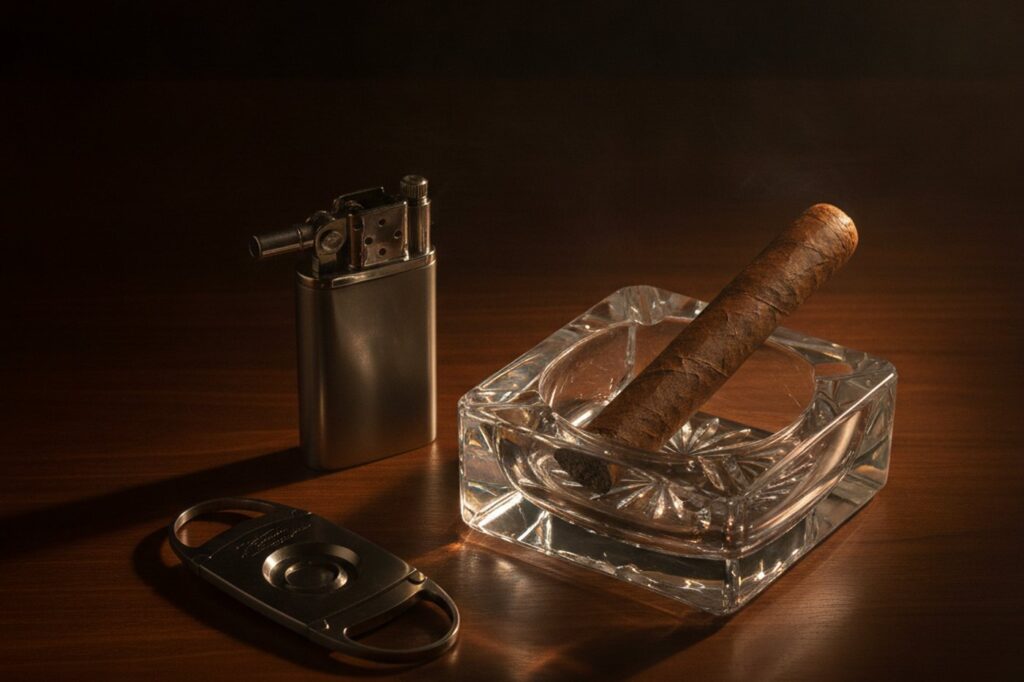
A cigar arrives at your hands as a finished object. Someone selected the leaves, someone else bunched and rolled them, and the thing has then spent months — sometimes years — reaching a state where it is ready to be smoked. All of that can be undone in half a minute by a blunt blade and a petrol lighter.
This is not fussiness. The cut governs how the smoke is drawn and how much of the wrapper survives intact; the light governs what you taste for the first quarter of the cigar. Both are cheap to get right and expensive to get wrong.
Know what you are cutting
Three parts matter here. The wrapper is the outer leaf, the one that carries most of the aroma and all of the cosmetics. The cap is the small round piece of leaf glued over the head to close it. The shoulder is the line where the body of the cigar stops being straight and begins to curve into the head.
That shoulder is the landmark that matters. Cut above it — two to three millimetres above — and you open the draw while leaving the cap doing its job of holding the wrapper down. Cut at or below it and you remove the anchor: the wrapper has nothing holding its end, and over the next twenty minutes it starts to unwind in your fingers.
There is no ritual reason for this. It is mechanical.
Four tools, four different cuts
The straight guillotine
A double-blade guillotine is the default for roughly ninety per cent of formats, and for good reason. Two blades closing simultaneously from opposite sides support the cigar as they cut; a single blade pushes the head sideways and crushes before it severs. The cut is a clean disc, the draw opens fully, and the tool forgives a slightly inaccurate hand.
What to look for: hardened stainless steel, blades that meet without lateral play, and a spring or detent that keeps them closed in a pocket. Cheap alloys go blunt within a season and a blunt guillotine tears rather than cuts — you will see it as ragged fibres around the rim.
The V-cut
A V-cut — sometimes called a cat’s eye — presses a wedge-shaped channel into the head rather than removing a disc. It concentrates the draw down a groove, which some smokers find gives a fuller, more focused smoke on thicker ring gauges. It also leaves more of the cap intact, which helps on cigars whose wrapper is fragile.
Its weakness is depth. A V-cut that goes too deep produces a hot, over-open draw and can pool tar in the channel. On very thick ring gauges the wedge may simply not open enough of the head.
The punch
A punch removes a small cylinder from the centre of the cap. It is the most conservative cut available: minimal wrapper disturbance, nothing to unravel, and the tool itself is small enough to live on a keyring. For travel it is hard to beat.
It has two limits. It does not work on figurados — torpedoes, belicosos, anything with a tapered head — because there is no flat face to punch. And on a cigar that draws tightly to begin with, a punch may not open it enough; you will find yourself pulling hard and getting little.
Scissors
Cigar scissors give the most control in experienced hands and the worst results in inexperienced ones. Two independent blades mean two chances to skew the cut, and the head is unsupported while you close them. They are a tool worth growing into rather than starting with.
| Tool | Best for | Watch out for |
|---|---|---|
| Double-blade guillotine | Almost every format | Blunt blades tear the wrapper |
| V-cut | Thick ring gauges, fragile wrappers | Cutting too deep |
| Punch | Travel, tight-drawing cigars are a poor match | Useless on figurados |
| Scissors | Experienced hands, large heads | Skewed, crushing cuts |
Fire: butane, and effectively nothing else
Petrol lighters — the classic wick-and-flint type — burn a fuel whose combustion products are heavy, oily and persistent. Held against a cigar foot, they deposit those products on the tobacco you are about to draw through. The first four or five draws of a cigar lit this way carry a flavour that is nothing to do with the blend, and it does not fully clear.
Ordinary sulphur matches do the same in a different way: the sulphur head burns off in the first second or two, and if you take the flame to the cigar during that window you are seasoning the foot with it.
The correct fuels are two. Refined butane, in a jet or soft-flame lighter, burns to carbon dioxide and water and leaves nothing behind. Cedar spills — thin strips of Spanish cedar, lit from a candle or match and then used to light the cigar — are the traditional alternative and add a faint cedar note that most people consider a feature.
Between jet and soft flame there is a genuine trade-off. A jet is hotter, faster, and works outdoors in wind — which in a Dubai marina in February is not a trivial advantage. A soft flame is gentler and less likely to scorch if your technique is imprecise, but it will not survive a breeze. Many people own both.
How to actually light it
Lighting a cigar takes twenty to forty seconds and rewards patience.
- Hold the cigar at an angle, foot down, and keep the flame below the foot rather than touching it. You are toasting with radiant heat, not applying fire to leaf.
- Rotate slowly so the whole rim chars evenly. An uneven start becomes a canoeing burn ten minutes later, and canoeing is very hard to correct.
- When the rim glows evenly all round, draw gently while keeping the flame just below the foot. Two or three easy draws are enough.
- Blow across the lit foot once and look at it. You want an even orange ring, no dark segments.
- If one side lags, touch it up now rather than hoping.
Do not put the flame directly on the wrapper edge. Scorched wrapper tastes of scorched wrapper for the first inch.
The ashtray is not decoration
Cigar ash is doing a job while it stays on: it insulates the burning end and slows the burn, which keeps the smoke cooler. This is why cigar ashtrays are built the way they are — wide, long rests sized for a large ring gauge, and a deep bowl so a two-inch column of ash has somewhere to fall.
A cigarette ashtray, with its narrow notches and shallow dish, forces you to tap the ash off early and often. You will taste the difference in the last third.
Figurados are their own problem
Torpedoes, belicosos, perfectos — anything with a tapered head — change the arithmetic. There is no flat face, so a punch is out, and the shoulder is much further down the cigar than it looks, because the taper begins early.
The safe approach is to cut conservatively and in stages. Take a small amount off the tip, try the draw, and take more only if it is tight. A tapered head concentrates smoke into a narrow channel; cut too much and you lose exactly the effect the shape exists to produce. Cut it flat across a wide point and you have simply made an ordinary cigar with a strange silhouette.
Some smokers cut figurados at an angle rather than square. It works, but it needs a sharp double blade and a steady hand, and there is no way back if the angle is wrong.
Looking after the tools
A cutter is a blade, and blades need the same three things they have always needed. Keep it dry — the humidity of a cigar bag and the salt in coastal air will pit cheap steel within a season. Wipe the blades occasionally; tobacco oils build up on the cutting edges and drag. And do not carry a guillotine loose in a pocket with keys, which is the fastest way to chip an edge.
Lighters ask for one discipline that most people skip: purge before refilling. Hold the lighter upside down and press the fill valve with a small screwdriver until it stops hissing. That releases the air and residual gas that has accumulated in the tank. Refill in a slow, steady press rather than a series of short bursts, then let the lighter sit for a couple of minutes before striking — butane arrives cold and needs to come back to room temperature, and lighting it immediately gives a weak, sputtering flame that people mistake for a fault.
Use refined butane with a high filtration rating. Cheap gas carries impurities that clog the jet, and a clogged jet is usually diagnosed as a broken lighter and thrown away.
A short list of avoidable mistakes
- Cutting too much. You can always take more off; you cannot put it back.
- Cutting with a blunt blade. If the rim looks ragged, replace the tool.
- Rushing the light. Thirty seconds now saves an uneven burn for the next hour.
- Relighting cold. A cigar left for more than a few minutes should have the ash knocked off and the foot re-toasted, not simply set on fire again.
- Drawing too often. Roughly one draw a minute. More than that overheats the cigar and turns it bitter — the single most common cause of a cigar “going bad” halfway.
Frequently asked
Which cutter should I buy first?
A double-blade stainless steel guillotine. It handles almost every format, gives a clean cut and forgives an inexact hand. Add a punch later for travel.
Is a jet lighter bad for cigars?
No, provided you keep the flame below the foot and do not hold it against the leaf. A jet is hotter, so it is less forgiving of poor technique — but it is the only realistic choice outdoors.
Why did my wrapper start unravelling?
Almost always because the cut went at or below the shoulder and removed the cap that was holding the wrapper in place.
How long should the ash stay on?
Until it falls or reaches roughly an inch. It is insulating the burning end and keeping the smoke cool; knocking it off early makes the cigar burn hotter.
My cigar keeps going out. What am I doing wrong?
Usually one of three things: it is over-humidified, it was lit unevenly, or you are drawing too seldom. Check humidity first — a cigar above 75% will fight you all evening.