
Designing a cigar room people actually want to sit in
Air exchange first, furniture second. Rooms that get this order wrong stop being pleasant within a season.
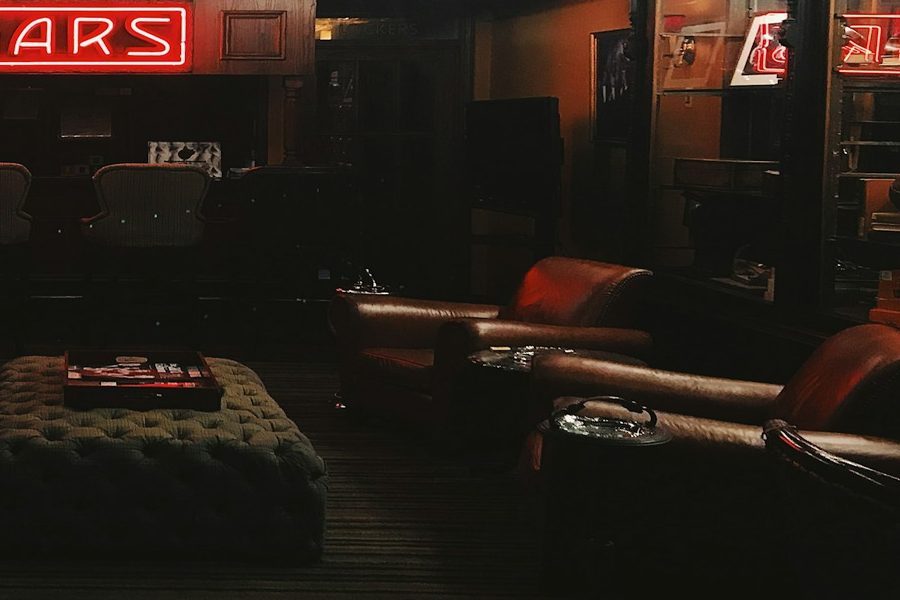
Most cigar rooms are designed the way most rooms are designed: someone chooses the leather, someone chooses the lighting, and ventilation is whatever the building already had. Six months later the room smells stale on a Tuesday morning, the upholstery has taken on a permanent character, and the owner concludes that cigar rooms simply smell like that.
They do not have to. But the order of decisions has to be inverted. In a cigar room, air handling is the primary design constraint and everything else arranges itself around it.
Start with the air, not the floor plan
Two mechanisms are at work, and they are different problems.
Air exchange replaces the air in the room with fresh air from outside. It is what stops carbon monoxide and particulates accumulating and what stops the room feeling heavy after two hours. It requires ducting, an extract path and make-up air — you cannot extract from a sealed room without providing air for it to pull in, or the extract fan simply stalls against negative pressure.
Filtration cleans the air that is already in the room. It removes tar, particulates, ammonia and formaldehyde, and it works continuously rather than in exchanges per hour. A good purifier makes a room comfortable during a session. It does not replace exchange, and no manufacturer claims it does.
A room with filtration and no exchange feels acceptable for an hour and oppressive by the third. A room with exchange and no filtration is fresh but hazy. You want both, and the balance depends on how many people smoke simultaneously and for how long — which is why we survey the space rather than quoting from floor area.
What a purifier actually removes
Tobacco combustion produces a long list of compounds. The ones that matter for a room are tar and particulate matter, which is what settles on surfaces and creates the film you eventually see on glass; ammonia and formaldehyde, which are the sharp components of the smell; and a large family of gaseous and oily compounds that carry the heavier notes.
Units built for cigar lounges — the U-Neo tower and its desktop equivalents among them — stack three stages: a pre-filter for large particles, an activated carbon layer for gaseous compounds and odour, and a fine filter for the small particulate fraction. Several also run a negative-ion mode, which helps particles clump so the filters can catch them.
Two practical notes that rarely appear in brochures. First, filters are consumables and they are not cheap — budget for replacement by running hours, not by calendar. A lounge running twelve hours a day burns through them far faster than a private room used at weekends. Second, a purifier should not remove the smell entirely. A faint cigar aroma is part of what people came for; what you are removing is the heavy, stale fraction that lingers the next morning.
Where the humidor goes
Cabinet humidors in a lounge have one enemy and it is the same one as at home: the air-conditioning outlet. Position the cabinet away from vents and away from the extract path, both of which will pull moisture out of it every hour it runs.
Access matters as much as climate. A display cabinet that guests browse should be reachable without walking through the seating area, and it should open toward the light rather than into a corner. A back-of-house humidor holding stock has different priorities: capacity, shelving in Spanish cedar, and an electronic system holding sixteen to twenty-two degrees and sixty to seventy-five per cent humidity without drift.
In the Emirates, one more consideration: cabinets are usually delivered into buildings with lifts and narrow service corridors. Check the route before ordering a unit the size of a wardrobe. We ask about the floor and the lift for exactly this reason, and it has saved more than one client an expensive return.
Materials, and what smoke does to them
Smoke settles into porous, fibrous surfaces and stays there. That single sentence dictates most material choices in a cigar room.
- Leather over fabric for seating. Leather can be wiped; woven upholstery holds odour permanently and cannot be cleaned in place.
- Hard flooring over carpet. If a rug is needed for acoustics, choose one that can be sent out for cleaning.
- Washable or sealed wall finishes. Matt emulsion absorbs; a wipeable finish or timber panelling with a sealed surface does not.
- Minimal soft window treatments. Heavy curtains are among the worst offenders in a smoking room.
- Glass and metal for display. They show film sooner, which sounds like a disadvantage and is actually useful — they tell you when filtration is falling behind.
Ceiling height helps more than any material choice. Smoke stratifies upward; a room with three metres of headroom keeps the smoke layer above seated head height for far longer than one with two-four.
Seating, ashtrays and the geometry of a good evening
The functional unit of a cigar lounge is not the chair. It is the chair plus a place to set a cigar down within easy reach of a seated arm — roughly sixty to seventy centimetres.
Get this wrong and people hold their cigars continuously, which sounds harmless and is not: a cigar held in the hand is drawn more often, and a cigar drawn more often burns hot and turns bitter. Ashtray stands beside each chair, or a low table shared between two, solve it entirely.
Group seating in twos and threes rather than long rows. Cigar conversation is quiet and slow; a row of chairs facing a screen produces neither.
Light and sound
Lighting should be warm and low, with pools rather than uniform brightness — partly because it suits the room and partly because a cigar is examined by eye more than people realise, and a warm light shows the wrapper honestly. Avoid cool white; it makes tobacco look grey.
Acoustics get forgotten because the obvious absorbers — carpet, heavy curtains, fabric panels — are exactly what you cannot use. The workable answers are perforated timber panelling with sealed surfaces, slatted ceilings with a wipeable backing, and bookshelves, which scatter sound without holding much smoke.
What happens after handover
A cigar room is a piece of equipment, not just a space, and it has a running cost:
- Filters on the purification units, replaced by running hours.
- Humidor servicing — element or reservoir checks, hygrometer calibration once a year, seal inspection.
- Extract cleaning — ducting accumulates tar and needs scheduled attention, both for smell and for fire safety.
- Staff routine — who checks the humidor readings, who logs filter hours, who empties and washes ashtrays rather than wiping them.
We hand rooms over with that routine written down and the staff walked through it once. A room maintained on a schedule stays pleasant for years; a room maintained by whoever notices first does not.
The order of decisions
If you take one thing from this article, take the sequence. Survey the space and calculate air exchange. Specify filtration to match the expected occupancy. Place the humidor away from vents and confirm the delivery route. Choose materials that do not hold smoke. Then, and only then, decide what the room looks like.
Done in that order, a cigar room is a pleasure on its five-hundredth evening. Done in reverse, it is a handsome room that no one wants to sit in by the following spring.
Frequently asked
How much air exchange does a cigar room need?
It depends on volume and how many people smoke at once, so it is calculated at survey rather than estimated from floor area. What is constant is that extract needs a make-up air path — extracting from a sealed room does very little.
Will a purifier remove the smell completely?
No, and it should not. It removes the heavy, stale fraction that lingers overnight. A faint cigar aroma is part of the room.
How often do filters need replacing?
By running hours rather than by the calendar. A lounge open twelve hours a day gets through them several times faster than a private room used at weekends; the units display remaining life.
Can a cigar room share air conditioning with the rest of the building?
Only if the smoking room is kept at negative pressure relative to adjacent spaces and its air is extracted rather than recirculated. Otherwise the smell travels through the system.
What is the most common mistake you see?
Choosing furniture and finishes first and treating ventilation as something to solve afterwards. It is almost always more expensive to retrofit than to plan.