
Keeping cigars in the Gulf: what a humidor is really fighting
The enemy is not the heat outside. It is the air conditioning inside — and it never takes a day off.
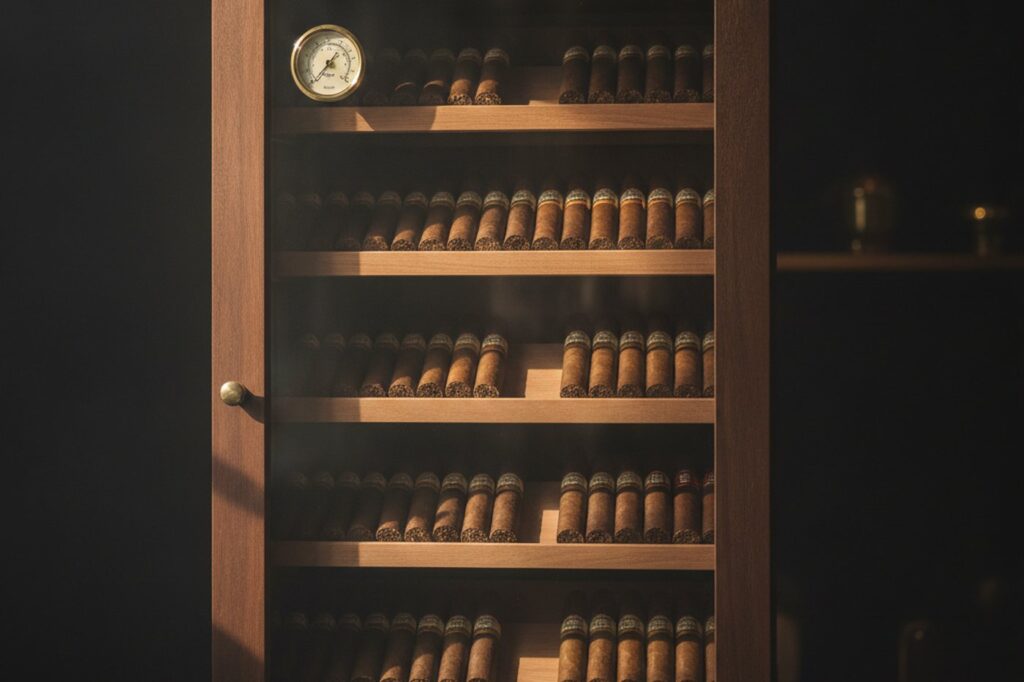
Ask anyone who has moved a cigar collection to the Emirates what went wrong first, and the answer is almost always the same: they prepared for the heat. Forty-plus degrees outside, humidity off the Gulf sitting somewhere between fifty and sixty per cent — it sounds like a climate that would look after cigars on its own.
Then the cigars come indoors, and indoors is a different country. Air conditioning does not merely cool air; it dehumidifies it as a by-product of cooling. A room held at 22 °C by a split unit running most of the day will often sit at thirty to forty per cent relative humidity. That is drier than the desert outside, and unlike the desert it is like that all year.
Everything that follows in this article is downstream of that one fact. A humidor in Dubai is not protecting cigars from the outdoors. It is protecting them from the room they are standing in.
What actually happens to a drying cigar
A cigar losing moisture does not fail all at once. The wrapper — the thin outer leaf that carries most of the aroma — gives up water first, because it has the largest surface area and the least mass. It shrinks fractionally against the filler underneath, and the seams start to lift. You will often see this before you taste it: a slightly raised edge along the seam, a cap that no longer sits flush.
Taste follows. The burn accelerates, because dry tobacco takes fire more readily than conditioned tobacco. A cigar that should have given you ninety minutes gives you fifty, and the last third turns hot and bitter as the burn line races ahead of the smoke it should be cooling. The characteristic note people describe as “harsh” is very often not the blend at all — it is simply a dry cigar burning too fast.
The reverse case is rarer but worse. Over-humidified cigars will not draw, refuse to stay lit, and in a warm room they invite mould. Between roughly sixty-five and seventy-five per cent relative humidity a cigar is fine; below sixty it degrades; above eighty you are running a risk you do not need to run.
Seasoning: the step most people skip
A new humidor arrives dry. The Spanish cedar inside it has spent weeks in a workshop and then in a shipping container, and cedar is hygroscopic — it will take moisture from wherever it can get it. If the first thing you put inside is a box of cigars, the cedar takes the moisture from them.
Seasoning is the process of giving the wood its own water first. It is not difficult, but it takes patience:
- Wipe the interior — walls, lid, trays and dividers — with a lint-free cloth dampened in distilled water. Damp, not wet. Standing water swells joints and can lift veneer.
- Charge the humidification element that came with the humidor, again with distilled water only, and set it inside.
- Close the lid and leave it alone for forty-eight hours.
- Check the hygrometer. If it reads below sixty-five per cent, repeat the cycle.
Most desktop humidors need two rounds. A large cabinet may need three. It is tempting to shorten this, and the cost of shortening it is paid by the first cigars you store.
Distilled water is not a fussy detail. Tap water in the Emirates is largely desalinated and still carries dissolved minerals; those minerals stay behind in the element and gradually block it. Propylene glycol solutions have their advocates, but they hold humidity at a fixed point rather than tracking the room, and they leave residue on the foam over time.
Your hygrometer is probably lying
Analogue hygrometers ship uncalibrated more often than not, and a needle that is eight per cent optimistic will convince you everything is fine while your collection quietly dries out.
The salt test settles the question in an evening. Put a teaspoon of table salt in a bottle cap, add a few drops of water until it is slushy but not dissolved, and seal it in a zip bag with the hygrometer for eight hours. Saturated salt solution holds the air above it at exactly seventy-five per cent relative humidity. Whatever your hygrometer reads at the end of that is its error. Some instruments have an adjustment screw on the back; on the rest you simply remember the offset.
Digital hygrometers drift too, just more slowly. Test them once a year.
Desktop, travel or cabinet
The three formats are not a ladder of quality. They solve different problems.
A desktop humidor suits a working collection — anything from twenty-five to a hundred cigars that you actually intend to smoke over the coming months. Look at two things before anything else: the seal and the lining. A well-made lid closes with a soft resistance and a faint sigh of displaced air; a lid that drops shut with a clack is not sealing. The lining should be Spanish cedar of real thickness, six to eight millimetres. Thin veneer photographs identically and behaves nothing alike: at that thickness cedar smells of cedar but buffers almost nothing.
A travel humidor or case is a different tool. It protects mechanically — against crushing in a bag — and holds conditions for days, not months. For a weekend, a sealed tube or a leather case is enough. For a week, choose a case with a small humidification element. Anything longer and you want a proper travel humidor with a gasket.
An electronic cabinet is what a collection graduates to, and what any lounge, restaurant or bar needs from day one. A unit such as the Raching C150A PRO holds sixteen to twenty-two degrees and sixty to seventy-five per cent humidity within about two per cent, using vertical air cooling and a compressor rather than a thermoelectric element. Shelves are Spanish cedar. The reason this matters commercially is simple: stock that sits for months has to be held at spec regardless of what the room does, and no passive box will do that against a Gulf summer.
Where you put it decides half the outcome
The single most common installation mistake in the Emirates is placing a humidor on a console directly beneath an air-conditioning outlet. The cabinet then spends its life fighting a jet of dry, cold air aimed at it. The seal loses, eventually.
Keep humidors away from vents and away from direct sun through glass. Interior walls are better than exterior ones. If you are specifying a walk-in or a built-in cabinet, the air-conditioning layout should be part of the drawing, not something discovered afterwards.
Living with it
A few habits do more than any equipment upgrade:
- Do not overfill. Air needs to move between cigars. A box packed solid develops pockets that sit at different humidity from the rest.
- Rotate. Every couple of months, move cigars from the bottom of the stack to the top. Humidity stratifies inside any box.
- Rest new arrivals. Cigars that have travelled — and in the Emirates, everything has travelled — want two to four weeks in stable conditions before they show what they are. Smoking one the evening it arrives tells you about the journey, not the cigar.
- Open the lid rarely and briefly. Every opening is a small reset. Decide what you are taking out before you lift the lid.
- Recharge on a schedule, not on a reading. By the time the hygrometer has fallen, the wood has already given up moisture.
When something has gone wrong
A cigar that has dried out slowly can sometimes be brought back slowly — emphasis on slowly. Raise humidity in stages over several weeks rather than putting a dry cigar into a seventy-two per cent environment, which will make the wrapper swell faster than the filler and split it. Recovery is never complete; some volatile compounds are gone for good. Treat it as salvage rather than repair.
Mould, unlike bloom, is fuzzy, blue-green, and grows in three dimensions. Plume — the harmless crystalline bloom that appears on well-aged cigars — is flat, white and brushes off. If you find real mould, remove the affected cigars, wipe the interior with a dry cloth, and reduce humidity before you do anything else.
Frequently asked
What humidity should I actually aim for in the UAE?
Between 65% and 70% is a safer target here than the classic 70%. Rooms with heavy air conditioning cycle more than European rooms, and the lower set point gives you margin when the humidor is opened.
How often do I recharge the humidification element?
By schedule rather than by reading — typically every three to four weeks for a desktop humidor in an air-conditioned room. Waiting for the hygrometer to drop means the cedar has already given up moisture.
Is an electronic humidor worth it for a home collection?
Below roughly a hundred cigars, a good passive box with a proper seal is enough. Above that, or if the room swings hard between day and night, an electronic cabinet stops being a luxury.
Can I keep cigars in the fridge?
No. A refrigerator dehumidifies aggressively and holds temperatures well below the range cigars want, and the cigars will pick up odours from food.
Do I need to season a travel case as well?
If it has a humidification element, yes — briefly. A sealed tube without an element needs nothing.